January 06, 2026
As a leading representative of new large-scale energy storage technologies, flow batteries are playing an increasingly crucial role in the new energy revolution due to their high safety and flexible scalability. As the core physical carrier of the energy storage system, the assembly quality and efficiency of capacity containers directly impact the overall system's performance and deployment speed. To address this, Shuntian Equipment has successfully developed an intelligent manufacturing assembly line for flow battery capacity containers. By deeply integrating systematic process optimization with intelligent technology, it propels flow battery manufacturing into a new era of efficiency, precision, and flexibility.
Overall System Architecture: Optimized Design Based on a Linear Flow Line
The core of this assembly system adopts a mature linear flow line production model. By scientifically breaking down the production process into a series of logically coherent and clearly defined specialized workstations, it achieves efficient and orderly assembly operations. Each workstation handles standardized processes, establishing a stable production rhythm. Materials and semi-finished products flow linearly via a conveying system, ensuring seamless transitions and precise movement between processes.
This architecture significantly reduces work-in-progress waiting times and handling losses between processes. Standardized operations ensure quality control at every stage, laying a solid technological foundation for large-scale batch production and comprehensively enhancing assembly efficiency and consistency.

Analysis of Core Workstation Technologies: Deep Integration of Modularity and Intelligence
1. Flexible Liquid Storage Tank Installation Workstation
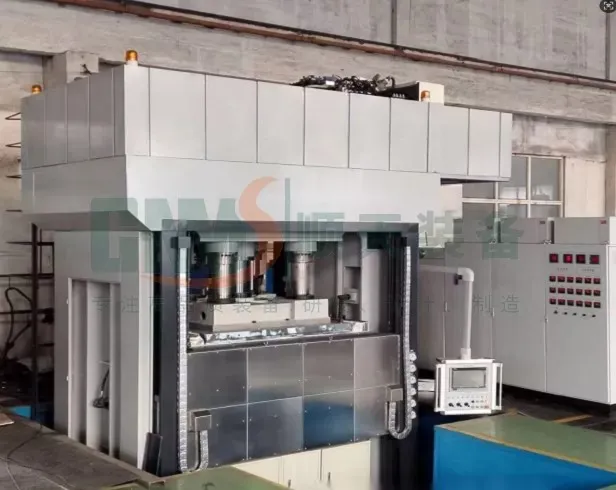
This workstation embodies the system's flexibility and adaptability. It innovatively employs a dual-station parallel design, allowing two liquid storage tanks to operate alternately between the preparation and installation areas. While one tank is being positioned and fastened, another pre-processed tank is ready for installation, significantly reducing equipment idle time. Crucially, the workstation's structure and fixture system are meticulously calculated and designed to offer excellent compatibility with multiple specifications. By quickly replacing positioning modules or adjusting parameters, the production line can seamlessly adapt to liquid storage tanks of different volumes and sizes, easily meeting customized customer demands and product iteration upgrades. This enables a single production line to manufacture a diverse range of products.
2. Automated TPU Bag Installation Unit
Addressing the traditionally manual, high-precision, and consistency-dependent process of TPU (thermoplastic polyurethane) bag installation, the system provides a revolutionary solution. The installation process utilizes two sets of high-precision servo-driven hooking mechanisms that perform precise, synchronized relative movements. Operators only need to preliminarily place the TPU bag in the designated area and press a button. The mechanisms then automatically complete the bag's tensioning, alignment, and hanging fixation. The entire process is visualizable and programmable, ensuring uniform installation tension and precise positioning. This design completely eliminates quality variations and damage risks associated with manual operations, significantly improving installation speed and product reliability.
3. Integrated Cover Plate Handling and Assembly Center
This workstation exemplifies the system's high level of integration, consolidating multiple operations involved in the entire lifecycle of a capacity container's cover plate into a single unit. The process is fully automated: a robotic arm first precisely removes the cover plate from the container. The cover plate then automatically enters a built-in three-dimensional buffer storage system, which can manage multiple plates in an orderly fashion following a first-in, first-out principle based on the production rhythm. When required, the system automatically retrieves a stored cover plate, and another mechanical device precisely installs it back onto the container body. The most forward-thinking design element is the integration of an automatic glue dispensing and bonding station before the storage stage, specifically dedicated to accurately attaching the insulation barrel (insulation layer component). This ensures that the cover plate completes the assembly of all critical accessories in one go before entering the assembly or storage state, avoiding efficiency losses, quality risks, and additional logistical handling associated with subsequent step-by-step operations.

System Advantages and Value Creation
Through the aforementioned innovative designs, this assembly system achieves a multi-dimensional leap in value:
● Significant Efficiency Improvement: Leveraging rhythm-based flow line production and multi-process parallel operations, the assembly cycle for a single container is greatly shortened, effectively boosting production capacity.
● Precise Quality Control: Automation of key processes eliminates variations from manual operations, ensuring product consistency and high conformity with design standards.
● Enhanced Flexible Response Capability: The modular structure supports rapid line changeovers and adaptations, enabling flexible responses to multi-specification, customized, and small-batch orders.
● Optimized Human-Machine Collaboration: Reduces the physical strain and reliance on complex skills for operators, improves the working environment and operational safety, and enhances job sustainability.
● Integrated and Streamlined Processes: Integrated workstations reduce intermediate work-in-progress storage and transfer links, minimize production footprint and logistical waste, and optimize overall operational costs.

Application Areas and Industry Prospects
This series of intelligent assembly equipment precisely serves the core manufacturing segments of the flow battery industry chain and is applicable to the following key assembly scenarios:
● Complete Assembly of Capacity Containers: Provides a complete flow line solution from frame construction to core component installation, enabling systematic assembly of the container structure.
● Full-Process Cover Plate Handling Center: Integrates cover plate removal, intelligent buffering, accessory mounting, and precise reinstallation, achieving integrated management of cover plate processes.
● Flexible Liquid Storage Tank Installation Workstation: Features multi-specification compatibility, supporting high-precision, high-efficiency positioning and installation of liquid storage tanks of various sizes.
As the global energy transition accelerates, the demand for large-scale, long-duration energy storage is experiencing explosive growth. The intelligent manufacturing assembly system for flow battery capacity containers has emerged in response to this trend. It represents not only a technological upgrade of production tools but also a significant innovation in manufacturing philosophy.
Deeply integrating mechanical engineering, automation control, and production management, this capacity container assembly line constructs a highly efficient, reliable, and flexible manufacturing platform. It substantially enhances the delivery quality and production efficiency of flow battery products, providing solid equipment support for the large-scale, standardized construction of energy storage power plants. In the future, this system will continue to drive the clean energy industry toward greater efficiency, cost-effectiveness, and sustainability.


 中文
中文