December 20, 2025
Why does professional installation and commissioning service determine 80% of your investment value?
Purchasing a large-scale stack assembly servo hydraulic press is merely the starting point of your investment. True value realisation begins the moment the equipment arrives at your factory. Data indicates that over 60% of equipment performance issues and early failures stem from non-standard installation and commissioning. Professional services can reduce your equipment's time to full production by 40% while ensuring long-term stable operation. This article delves into the critical processes of professional installation and commissioning, revealing how they maximise your return on investment.
Why is professional installation and commissioning irreplaceable? — Mitigating risks, unlocking value
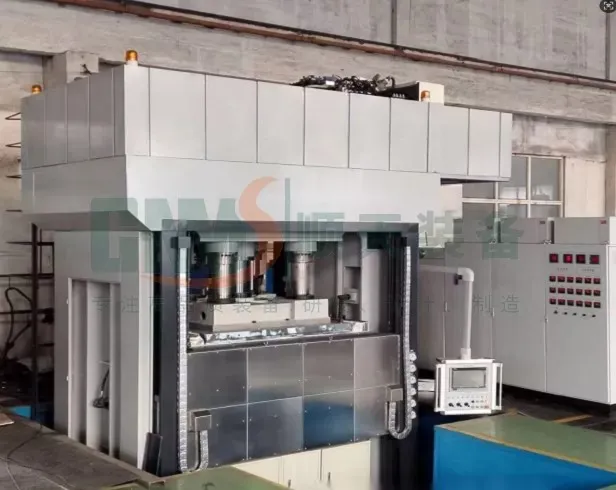
Large-scale hydraulic presses for stack assembly integrate high-precision mechanics, complex hydraulics, and intelligent controls. Their installation and commissioning extend far beyond mere ‘positioning and powering up’. Non-professional handling triggers a cascade of risks:
● Foundational risks: Uneven foundation bearing capacity or misaligned levelling can cause latent deformation of the machine body, permanently compromising foundational precision and undermining subsequent processing quality.
● Systemic risks: Inadequate hydraulic line cleaning allows micron-level contaminants to cause servo valve sticking and internal leakage, triggering pressure fluctuations and sluggish operation. This incurs high maintenance costs and prolonged production downtime.
● Process risks: Failure to scientifically calibrate and match press-fitting speed, pressure curves, and closed-loop parameters may result in uneven stack compaction and low yield rates at best, or batch-level product scrap at worst.
● Safety risks: Improper configuration of mechanical stops, safety interlocks, and electrical protections directly jeopardises personnel and equipment safety, with potentially catastrophic consequences.
Professional installation and commissioning services proactively identify and eliminate these risks through a systematic, standardised, and verifiable engineering process. This ensures the complex manufacturing system commences production at its designed peak performance, safeguarding the fundamental security and core value of your multi-million investment. It is not merely installing equipment, but establishing the most robust foundation for long-term, stable output.

The Six-Step Precision Commissioning Methodology – The Value Engine from Accurate Implementation to Exceptional Production
An exceptional installation and commissioning service constitutes an interlinked, multi-tiered verification system. It ensures the seamless transition of value for large precision equipment, ultimately unlocking its full potential on your production line:
Step One: Preliminary Site Survey and Precision Preparation
Prior to equipment arrival, our specialist team completes comprehensive site assessments. Laser scanning verifies foundation load-bearing capacity and levelness, while meticulously planning utility interfaces (power, gas, cooling) and logistics pathways. This ensures the site meets stringent requirements, eliminating installation deviations at source.
Step Two: Mechanical Positioning and Precision Foundation
Employing specialised tools such as hydraulic jacks and laser trackers, the machinery is positioned with stress-free precision. Multi-stage static and dynamic levelling adjusts the equipment's base frame to micrometre-level global accuracy, establishing an immutable geometric reference for all subsequent movements.
Step Three: Electrical and Control System Neural Connectivity
Precise calibration and verification of high-resolution sensors (e.g., linear encoders, pressure transducers) is completed. Comprehensive testing of safety circuits, emergency stop chains, and mechanical interlocks ensures absolute safety. Simultaneously, seamless data integration with the factory MES/ERP systems is achieved, imbuing the equipment with intelligent functionality.
Step Four: Hydraulic System and Core Function Activation
Execute rigorous hydraulic circuit flushing to ensure oil cleanliness exceeds NAS 7 standards. Conduct tiered fine-tuning of servo pumps, proportional valves, and actuators, completing performance validation from no-load cycles to progressive full-load stages. This guarantees swift power system response, smooth operation, and optimal energy efficiency.
Step Five: Process Parameter Development and Optimisation
This step addresses the core of production. Utilising your actual stack materials and components, multiple rounds of process pressure testing are conducted. Through data collection and analysis, the optimal press curve (pressure-position-speed closed-loop control) tailored to your specific product is developed and finalised, forming an exclusive ‘process recipe’ that ensures product consistency, yield, and efficiency.
Step Six: Comprehensive Training and Final Acceptance
Deliver tiered, in-depth training for your operational, process and maintenance teams, covering daily operations, process adjustments, preventative maintenance and fault diagnosis. Ultimately, validate the equipment's overall performance and reliability at the specified production rate through continuous stability testing, completing formal acceptance to ensure you can fully operate the equipment independently.
This rigorous six-step standardised journey transforms complex installation and commissioning into a predictable, manageable value realisation process. What we ultimately deliver is not merely a machine, but a reliable production line ready for immediate high-quality manufacturing.

Beyond Installation: Elevating Value from ‘Equipment Adjustment’ to ‘Capability Building’
Top-tier installation and commissioning services deliver far more than a functioning machine. They provide a complete ‘productivity package’:
1. Precise process parameters: Mature pressing programmes tailored for each of your stack products.
2. A professional team: Your staff equipped with core competencies in equipment operation, process adjustment, and basic maintenance.
3. A comprehensive knowledge system: Full documentation and data covering operation, maintenance, and fault diagnosis.
4. A stable production foundation: Equipment operating at optimal mass-production readiness and traceability from day one.
Golden Rules for Selecting Service Partners
How to identify a reliable service provider? Consider these five criteria:
1. Domain expertise: Deep understanding of stack manufacturing processes, not merely hydraulic machinery?
2. Process Standards: Do they maintain detailed, standardised operating procedures (SOPs) and acceptance criteria?
3. Technical Tools: Do they utilise high-precision inspection equipment such as laser interferometers and dynamic analysers?
4. Local Support: Can they provide rapid on-site response and sustained technical assistance?
5. Proven Track Record: Do they possess verifiable success cases with similar equipment within the same industry?
A top-tier piece of equipment is your competitive edge in the form of superior hardware; a top-tier installation and commissioning, however, is the core system and soul that activates this hardware. It determines whether this precision machinery enters the fray in peak condition or is shackled from the outset by invisible constraints.
When evaluating investments, professional installation and commissioning are not merely optional ‘follow-up procedures’ but must be regarded as a core component of the investment itself. It safeguards far more than the equipment's intrinsic value; it secures your very foundation for market survival over the coming years – stable product quality, efficient production output, and an unassailable market reputation.
Therefore, selecting professional installation and commissioning for your large-scale stack assembly servo hydraulic press transcends a mere service procurement. At its core, it is choosing the sole trustworthy cornerstone for your successful mass production and commercial future.


 中文
中文